Sector: Public sector
Flemish Transport Company De Lijn is responsible for the preparation, planning and implementation of all public transport by bus or tram in Flanders. The organisation consists of 5 operational entities, each with its own operational autonomy, and 1 central headquarters. It has a total annual budget of more than €1,000 million, the largest subdivisions of which are personnel costs and subcontracted bus and coach services. Since De Lijn regulates public transport at the request of the government, they also have to deal with subsidies, which requires transparent structures, reporting lines and systems.
Client requirement
De Lijn wanted to improve its operational insights in order to deliver a more efficient business strategy, which was necessary for the development of the 5-year management agreement with the government. The challenge was as follows:
- To improve operational and financial performance using consolidated data from the 5 entities and address quality issues;
- To develop reporting in order to be able to respond more quickly and effectively to ad hoc (government) queries;
- To improve internal efficiency in human resources management through reporting and analysis (Business Intelligence) and by reducing operational costs;
- To harmonise reporting.
De Lijn also wanted to be ready for the future by building and developing an 'Enterprise data warehouse'.
Approach
From a very early stage De Lijn was involved in the development of Business Intelligence and Data Warehousing. The current solution revolves around Business Intelligence and Performance Management, supporting all decision-making, planning and data processes. At its heart is the Enterprise Data Warehouse, which 'houses' all relevant data.
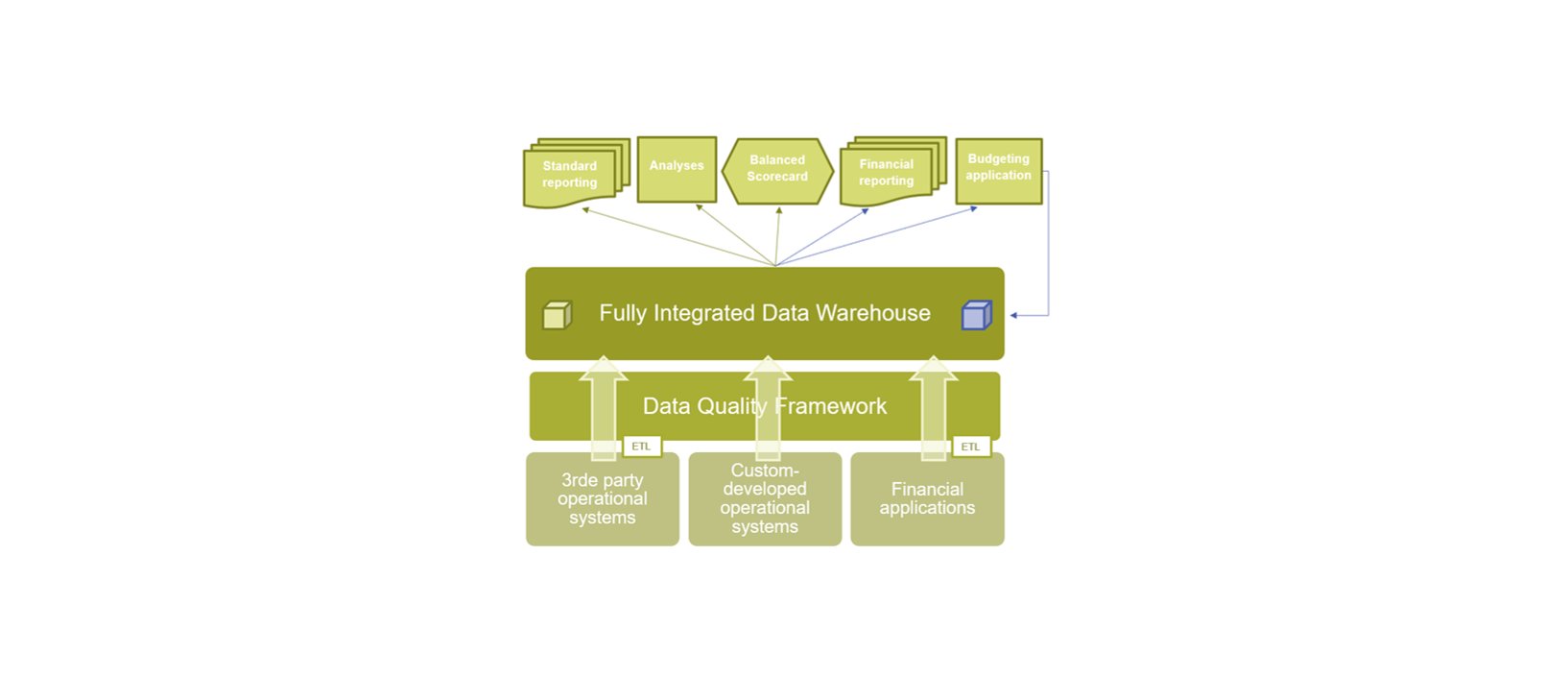
The technical component consists of the following:
- IBM DB2 database on Iseries;
- IBM Information Server/DataStage 8.1 for ETL and Data Quality processing;
- IBM Cognos BI 8.4 for reporting, analysis and scoreboard;
- IBM Cognos TM1 9.2 for analysis, planning and budgeting.
This led to the development of a concept based on three main parameters:
- A new Enterprise Data warehouse where all data is collated and stored;
- The development of a unique and central Business Intelligence platform;
- The creation of a planning and budgeting tool.
Obviously, this technically complex structure was always embedded within a change management programme aimed at stimulating technical know-how and its application by key individuals within the organisation.
Results
- Efficiency drives;
- Efficient budget management;
- A planning and budgeting tool that enables successful prospecting;
- Key corporate data becomes visible and leads to actual initiatives that improve the quality of the data;
- Integration of different domains: strategic planning, Project Portfolio Management, financial and budget reporting, all linked by the Performance Management architecture;
- Generalised use of Business Intelligence at all company levels.
Read the extensive customer case here!