

Every day, planners, customer service teams and supply chain professionals process hundreds of transactions: adjusting orders, tracking deliveries, contacting suppliers or resolving stock shortages. Studies show that operational employees spend up to 40% of their time on repetitive administrative tasks.The question is no longer whether AI agents will take over these activities, but who will teach them how the work is done today.
Where AI is making a difference today
When companies talk about artificial intelligence, the conversation often revolves around forecasting, analytics and strategic decision-making. In practice, however, AI agents are delivering the greatest impact in transactional processes such as order management, supplier communication, transport tracking and exception handling.
These processes follow clear patterns and are repeated dozens or even hundreds of times every day, making them ideal candidates for gradual automation. This is where organisations can currently achieve the greatest productivity gains.
Why operational knowledge is critical for AI agents
An AI agent does not learn from a job description. It learns from the way employees perform their work.
A planner knows which suppliers require closer follow-up. A customer service representative understands when a customer needs proactive communication. This knowledge often exists in people's experience rather than in systems or documentation.
That is why documenting processes, decision rules and exceptions is a critical step in any AI initiative. Without this knowledge, an AI agent lacks the foundation required to make decisions independently.
Process documentation makes hidden knowledge visible
Many operational processes still rely heavily on experience and informal agreements. Employees know which customers deviate from standard procedures or which transport providers can react fastest when problems arise. Yet this knowledge is often passed on verbally and disappears when employees leave the organisation.
Documenting processes does more than capture these implicit decision rules. It also helps uncover inefficiencies, unnecessary process steps, duplicate controls and unclear responsibilities.
By explicitly documenting workflows, RACI matrices and information flows, organisations can streamline their operations and data flows while simultaneously building a stronger foundation for future AI agents.
From support to autonomous execution
The most successful AI implementations typically follow a phased approach.
Initially, AI agents support employees by providing information, recommendations or alerts. Over time, they can independently execute simple transactions, such as answering standard enquiries or monitoring deliveries.
Only once sufficient trust has been established do they take ownership of larger parts of the process. As a result, employees gradually shift from executing tasks to supervising, improving processes and managing exceptions.
Process documentation as a competitive advantage
Within a few years, powerful AI technology will be accessible to virtually every organisation. Competitive advantage will no longer come from the technology itself, but from the quality of the knowledge that technology can leverage.
Every documented process step, exception and decision rule becomes a building block for future AI agents. What appears to be process documentation today will form the foundation of tomorrow's digital workforce.
AI agents will increasingly take over repetitive supply chain activities, but their success will depend on the knowledge organisations capture today. Companies that invest now in process documentation and knowledge retention are laying the foundations for the supply chain of the future.
Knowledge retention as the foundation for AI
Our methodology brings together organisational structures, processes, systems, data and operational knowledge to create a foundation for continuous improvement and future AI agents.
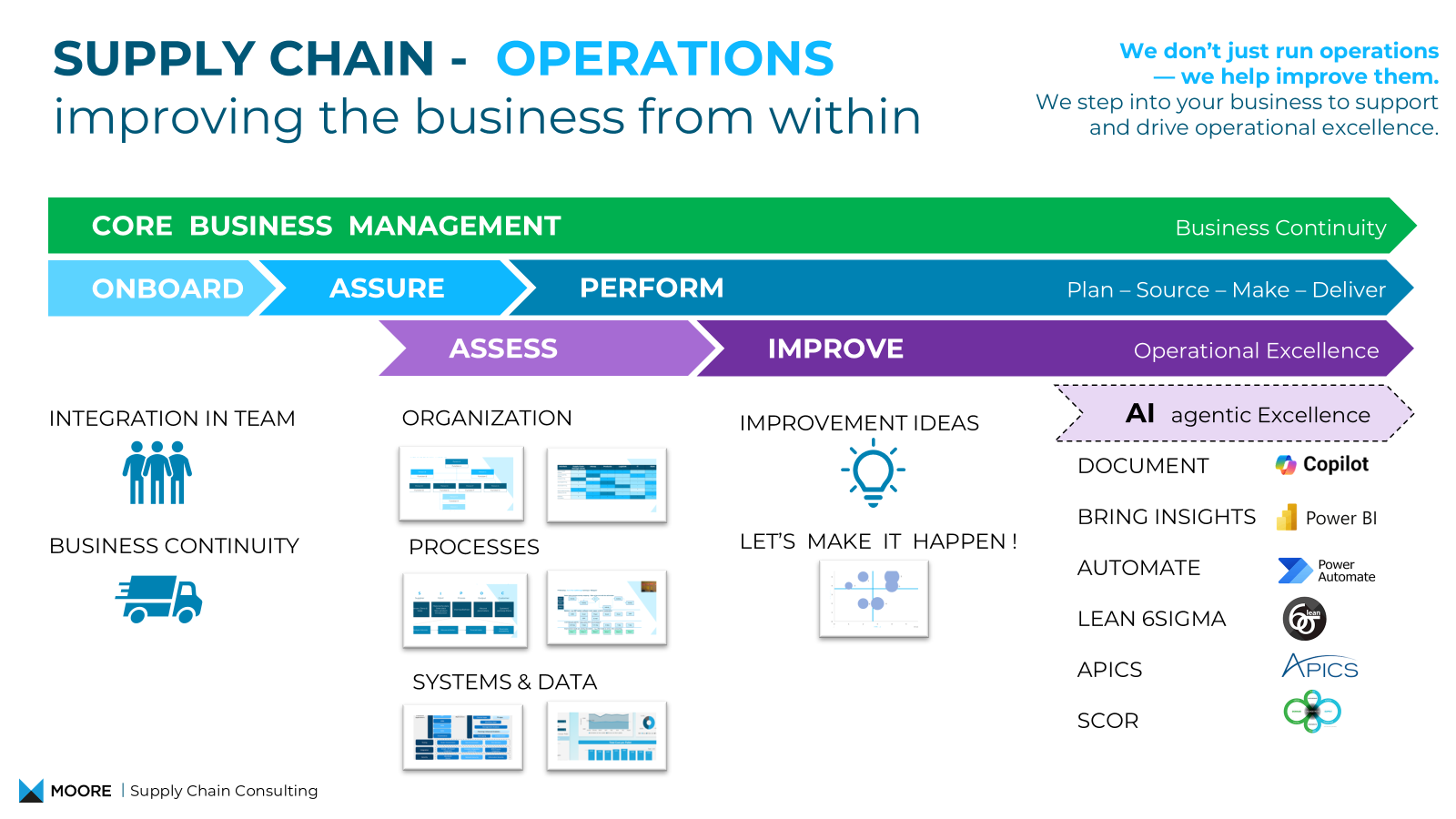
That is why, within our operational consulting projects, we document processes, systems, data, organisational structures and business context using a structured methodology. This knowledge is simultaneously embedded within the AI agents used by our consultants.
As a result, we deliver more than project outcomes. We also build a digital knowledge base that continues to create value long after the consultant has left the organisation.
In addition, this approach creates a foundation on which multiple AI agents, both current and future, can combine information from different systems, share knowledge and collaborate across processes, departments and applications.
Discover how we can help prepare your operations for the age of AI.